The horizontal screw centrifuge is a dedicated solid-liquid separation equipment designed for petroleum drilling fluid. It consists of a drum, screw, differential system, liquid level baffle, drive system, and control system. This equipment can complete feeding, centrifugal sedimentation, and unloading at full speed. Its main jobs are recovering barite, removing fine solids, reducing the solid content of drilling fluid, and controlling density and viscosity. In short, it keeps drilling fluid performing well and helps achieve rapid drilling.
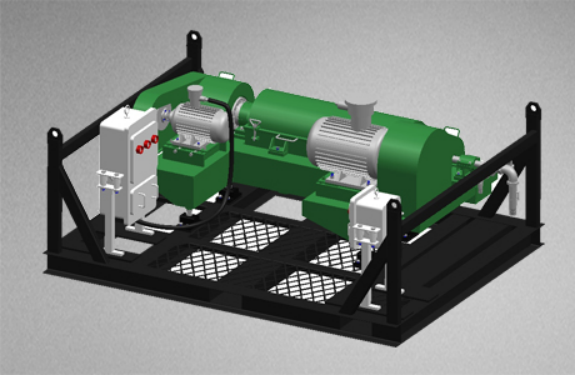
The working principle is centrifugal sedimentation. Suspension enters the drum through the feed pipe. Under centrifugal force, solid particles are pushed to the inner wall of the drum and discharged through the slag discharge port at the small end by the blades on the screw conveyor. The liquid phase overflows through the overflow hole at the large end. This cycle repeats continuously, achieving continuous separation.
The factors influencing the performance of horizontal screw centrifuges fall into three categories: non-adjustable mechanical factors, adjustable mechanical factors, and process factors.
Non-adjustable mechanical factors start with drum diameter and effective length. These directly affect the settlement area. The larger the diameter and length, the stronger the processing capacity. Next is the drum semi-cone angle. Increasing the cone angle helps improve the clarification effect, but it reduces slag conveying and dewatering efficiency. Pitch is another factor. If the pitch is too large, it increases the risk of material blockage and can cause vibration. For difficult-to-separate materials, a smaller pitch is recommended. Finally, spiral type matters — counter-flow and co-flow types perform differently, with counter-flow potentially interfering with separation by causing settled particles to float up again.
Adjustable mechanical factors give operators room to optimize. Drum speed affects the magnitude of centrifugal force. Increasing speed enhances solid-phase compaction, but too much speed damages floc structure, reduces dewatering effect, and increases energy consumption and equipment wear. Differential velocity (differential ratio) is another key adjustment. Increasing differential velocity enhances sludge discharge capacity, but it shortens dewatering time, leading to higher moisture content in the mud cake and lower filtrate quality. The thickness of the liquid ring layer is adjusted by changing the height of the liquid level baffle. Increasing thickness expands the sedimentation area and improves filtrate quality, but it shortens the drying zone and reduces solid content in the mud cake. Reducing thickness does the opposite. Keeping baffle heights consistent helps prevent equipment vibration.
Process factors also play a significant role. Before sludge dewatering, operators usually add an organic high-molecular flocculant such as PAM to improve dewatering performance. Chemical selection must consider both sludge characteristics and equipment operating conditions. Some flocculants that work well in laboratory tests perform poorly in the field simply because they do not match the equipment's operating conditions.
Understanding these three categories,non-adjustable mechanical, adjustable mechanical, and process factors,helps operators get the most from their horizontal screw centrifuge. Proper setup means better barite recovery, finer solids removal, lower fluid costs, and fewer drilling problems.
 EN
EN